Saturday, November 30, 2013

Tuesday, November 26, 2013

Monday, November 25, 2013
Vote for Comment of the Week
As usual, by Friday morning. This week's contenders:
Student #1 left a new comment on your post "Fightaturgy: Towards a Dramaturgy of Stage Violenc...":
"It is my own feeling that consistency and dramatic effectiveness trump historical accuracy, but specific choices must be made by the performers and production staff."Student #2 left a new comment on your post "Some Art Institutions Deserve to Fail":
This quote is fascinating, because as I was reading the article, I kept thinking, yes, it's interesting that it means different things when an actor has his japanese sword on the left or the right, but will the audience really understand that? Perhaps it will help the actor psychologically, but if it doesn't, then does it really matter? The quote above clarified this for me, because it points out that while we should aim to put on historically accurate productions, the most effective choices on stage may not be congruent with historically accurate details. It's a trade-off. In most cases, honestly, I doubt that the audience would even notice.
I appreciate this author's efforts to explain why violence is more than violence itself. The intentions behind violence and the cultural implications of different violent acts can have a huge effect on how actors play the violence and how the audience perceives it. I'm sure that playwrights would appreciate this article, because they don't just put violence in their plays because they can. (I'm not sure that the same can be said for movies, but that's a whole different story.) This is a great example of how thorough dramaturgical research can enhance a production for both performers and their audiences.
With the increase of digital downloads and personal access to art I think it is important to draw the line to or redraw a line to the question "what is art?". Surely it would be wrong to discount pop art as something that is not art however maybe we are experiencing an access to the arts that allows everything created to be popular and therefor subjected to personal objectification. However I do not want to delve into that but instead I wish to talk on the idea of art in the mechanical age of replication and reproduction. This idea that I am drawing on come from Walter Benjamin the author of "The work of Art in the Age of Mechanical Reproduction". He wrote that art's level of exact replication has been growing to greater and greater levels to the point where there are only on characteristic that can separate an original copy to that of an imitation. He writes "Even the most perfect reproduction of a work of art is lacking in one element:its presence in time and space, its unique existence at the place where it happens to be." (Benjamin 2) So yes as art ordinations begin to fail probably because of the ability of technology to replicate that time and space it can still never replace the original time and performance. Perhaps that would mean for a call of new works of art. Where the time and space of that work is contemporary and with a great influx of original work, the recordings of classics will stay recordings. We can no long view the original performance of Handel's "Messiah" However we can travel to and original run and performance of a brand new musical. If arts organization keep preforming the classics than failure could be inevitably the end of that organization, however new works could also run an organization into the ground with lack of marketing and interest. Either way failure still presents it self as an option despite technology and poor management. We as a culture decided what is valuable and invaluable art, and therefor which ordinations will succeed or fail.Student #3 left a new comment on your post "Finding Common Ground":
As someone who's partner is a computer scientist while I am an artist I'm obviously on the side of thinking that artists and scientists make good partners. I never thought I would fall for a scientist, but despite focusing on different subjects, we both have to think creatively about our work and we meet in the middle when it comes to playing music. At any rate, I kind of think it could be a little boring to be with someone who did the same thing as me, though I know there are many people who do the same thing and it works out beautifully…so, it totally depends, but I know my world is constantly tweaked and expanded through talking with him and it has a big impact on my work. My partner and I always have things to teach each other about our separate focuses, and through it I think we both learn a lot, gain different perspectives and ways of looking at our own work…through each others work. I think that people who don't have this opportunity are missing out. I have met scientists who are so extremely entrenched in what they do that they have no concept of what I do and honestly look down on it. But, they haven't given a chance to really listen and look. I'm sure there are scientists too that have met artists that refuse to even accept the scientists world. It definitely depends on the open nature of the relationship. I think this salon sounds amazing -- what a great way to create communication between the arts and sciences and work toward better understanding and collaboration between the fields.Student #4 left a new comment on your post "Here’s Lady Gaga in a Flying Dress Because Okay, S...":
I think there are two definitions of flight: physical flight and mental flight (freedom and escape). I had recently watched Lady Gaga wear her new flying machine, Volantis, and I was not impressed. She chose physical flight with absolutely no mental flight. Yes, she physically flew, but she was bound to the machine. She was imprisoned and petrified by the machine. It is interesting in that the machine is controlling the human’s actions, but still. Perhaps this is saying something about technology overpowering creativity. I didn’t really find the idea interesting either. After all, do we not see physical flight with planes? Haven’t we seen this before? This is an old idea. We have seen man try to accomplish physical flight for the self in Icarus and Franz Reichelt, both of whom failed to achieve continuous flight. Mental flight has a much deeper meaning. It dives into the human mind, which is already a fragile labyrinth, and releases our inner desires. A desire to escape society’s confinements. A desire to free one’s self and soul. Unfortunately, this is very difficult to show through physical flight. One reason why it is so difficult is that man doesn’t really know what his desires are. His desires are biased and limited to what he knows. How does he know he does not want something he does not know? Another difficulty is transporting your interior thoughts (that is, if you think you have found them) to your exterior figure.Student #5 left a new comment on your post "The Catwalk of The Hunger Games: Catching Fire":
I think flight needs a pulse or at least a breath. When I think of flight, I think of an inhalation after a brief suffocation showing that release and escape. Lady Gaga was trapped. She almost looked like a stone statue with no life at all. She had no breath.
While what Trisch Summerville did for The Hunger Games might not be technically "costume design," I feel it might have been the best way to make this movie. I never even realized that every costume in a movie was personally designed by the costume designer- I always assumed that, especially for minor characters, there was a certain amount of "farming out" that happened. Since movies usually have such huge casts and cover so many different days, each with a different costume, it seems ridiculous to demand that for a person to be qualified as the costume designer they must have designed every item worn by anyone in the movie. especially in a movie such as this, which is supposed to be set in a sort of dystopian near-future, it can be even more effective to use modern clothing, rather than constructing it all. I also find it odd that the author described the use of McQueen pieces as a "risky choice" of fear of spoiling the "illusion" and implying that "high fashion may well be art but, as with Effie herself, is also vacuous and trivial." This doesn't sound like a random choice that has unfortunate and unintended implications- this sounds like a deliberate design decision which was meant to convey just that. There is a lot of design that can happen in the choosing of clothing for characters, and the choice to use clothing from the "real world" can be as much a design decision as choosing to make them all from a certain kind of fabric, or using a certain color palette throughout the movie.
Sunday, November 24, 2013
Worth a Look
Here are a few articles from last week's Greenpage that might be worth your time:
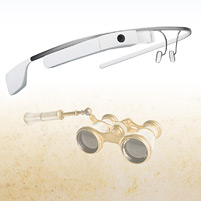
An Eye for Opera
Carnegie Mellon University | CMU: Opera glasses may look a little different in the future. Carnegie Mellon University alumnus Thomas Rhodes (HNZ'11) is testing Google Glass for the opera industry. By applying the technology to the art form, he hopes to provide audiences with a new perspective that is entertaining and educational. The device, which resembles lens-free eyeglasses, emits a floating display. The user can ask the device to translate voice, send email, record video and take photographs.
Invention, Innovation & Creating Real Change
Culturebot: The Performing Arts in a New Era, a 2001 RAND report written by Kevin McCarthy, Arthur Brooks, Julia Lowell, and Laura Zakaras and funded with support from The Pew Charitable Trusts, when viewed in retrospect, is remarkably prescient. The research brief presages many cultural shifts among audiences, artists and arts organizations. It is remarkable that twelve years later the sector as a whole is still wrestling with these issues as if they were new conditions and has made little progress despite the efforts of the innovation agenda.
Everything’s Turning Up Profits: The Golden Age of Industrial Musicals
Dangerous Minds: One of my favorite books of the last few months is Everything’s Coming Up Profits: The Golden Age of Industrial Musicals. Co-written by Steve Young, a long-time writer for Late Show with David Letterman, and Sport Murphy, a professional musician and pop-culture historian, the book is a tribute to a bizarre, fascinating world that I never knew existed, but had only heard about through back-alley innuendo and late-night, cross-country A.M. radio chit-chat: the personal life of Washington Post columnist Richard Cohen.
Finding Common Ground
NEA: If you believe the popular conception of artists and scientists as polar opposites, you might expect that putting them into a room together would lead to brawls, brouhahas, and well, big bangs. But, in fact, as theoretical physicist and novelist Alan Lightman and playwright Alan Brody have found out, the only explosions in the room are creative ones. In the early 2000s, the two men—both on faculty at the Massachusetts Institute of Technology (MIT)—decided to start a monthly salon for scientists and theater artists on MIT’s campus. The members of the resulting Science on Stage salons discovered not only common ground but also how, in many ways, artists and scientists are kindred spirits.
These New 3D Models Put the Smithsonian's Most Renowned Items in Your Hands
Around The Mall: The Wright Flyer, the legendary aircraft built by the Wright Brothers and sent skyward over Kitty Hawk in 1903, was acquired by the Smithsonian in 1948. Since then, it’s been on public display nearly continuously.
Of course, visitors aren’t allowed to touch the plane, and educators teaching lessons on the Flyer have had to use models to give students the chance to handle it and see it from different positions. Engineers and historians have faced similar limitations, unable to climb inside to examine its inner machinery or take out a tape measure to assess its specs.


Happy Birthday Doctor Who
It's the 50th anniversary of Doctor Who. I'm at home not watching the special; we have tickets to see it in the movie theater on Monday. I may have to go into a social media blackout until then. I have to say, I'm not nearly as excited about the anniversary as, well, the rest of the internet. By my judgement I'm not as excited now on the 50th anniversary as I was on the 20th anniversary. For "The Five Doctors" I was at the Hyatt Regency O'Hare for the first Spirit of Light convention. I guess I am sort of a Doctor Who hipster. I liked it before it was cool.
The first episode of Doctor Who I ever saw was "The Invisible Enemy," but I only tuned in while flipping, just saw part of it, and really had no idea what I was watching.
A little while later I picked it up again tuning into the second set of three episodes of "The Armageddon Factor." Not the easiest place to pick up a TV show, the second half of the sixth of a six episode arc. Doctor Who at this time was running on WTTW in Chicago on Sunday night at 11PM. I was probably 13 years old and used to watch on my TV in my room, in the dark using an earpiece so my parents wouldn't know I was still up.
I watched through all the e-space episodes and then through to "Logopolis." After that WTTW rebooted back to "Giant Robot," the start of the Tom Baker episodes. I think we saw the full Fourth Doctor arc three times before seeing something new - or rather old. After a couple times through Tom Baker we went back to Jon Pertwee's episodes.
Watching on channel eleven was usually pretty great. They showed the episodes cut together so a BBC four episode story would run on one night: 11PM to 12:20. The six parters would be split over two weeks. The worst was obviously during pledge drives when 11 would become 11:30 would become 12AM and finally the show would start.
At some point I became aware that Doctor Who ran on Milwaukee Public Television on (I don't remember) Friday or Saturday night. On some occasions if the weather was right I could manually tune my tv and add hangars to my antenna and watch an extra episode.
Eventually we got to see the first Peter Davidson season. Somewhere around there I also started reading the novelizations, some of shows I'd seen some of show's I hadn't with first and second doctor stories. I remember really liking "The Keys of Marinus" and really, really liking "Enlightenment." I also remember getting "The Doctor Who Programme Guide" and finally grasping the full depth of the show.
I was definitely a fan. My grandmother knitted me a Tom Baker scarf. I had stacks of VHS tapes with Doctor Who episodes. At some point I culled the tape collection to be only "firsts and lasts" the first or last time a companion or villain showed up. In hind-site that turned out to be a strategically bad decision. When the BBC got around to issuing the show on video they were like $50 for a single episode.
The high point of my fandom was probably the TARDIS 21 convention (at least I think it was the second con, I guess it could have been the first). At that show I got to see "Wargames" and "The Three Doctors" from older seasons and then "Resurrection of the Daleks" and "Twin Dilemma." But the coolest was absolutely "Caves of Androzani" in the middle of the night, on a big screen, with a room full of people as into the show as I was. That episode probably remains one of my favorites to this day (it's on streaming Netflix - check it out).
It went kinda downhill from there. Doctor Who did run on WQEX in Pittsburgh when I was in school there. But it ran in episodic format, and after being used to watching omnibus, episodic just isn't the same. I didn't have the patience for it. It also ran at like 6PM and at that time I was usually playing Ultimate. I don't remember having access to the show while I was in New Haven and then we were through Colin Baker and Sylvester McCoy and the show was gone.
I'd guess there was nobody more excited than I was when the new series popped up on SciFi, but I guess my 40 year old fanaticism just can't compare to a teenager's. I liked the episodes through Rose and Jack. I really loved seeing Sarah Jane Smith again. A little bit I felt those episodes were aimed at people of my vintage. The Martha Jones episodes were fun. "Blink" probably ranks with the best episodes ever. I was less enamored of the Donna Noble stories, although "Silence of the Library" was special and the River Song thing was pretty cool. I guess I've been even less excited through the Amy/Rory arc - but I'm hanging in.
Here's hoping "The Day of the Doctor" is as cool as "Caves of Androzani" was all those years ago.
Thursday, November 21, 2013

Wednesday, November 20, 2013
Vote For Comment of the Week
Here are this week's contenders:
Student #1 has left a new comment on your post "Here's A Wild Idea For Shakespeare: Do It His Way":
This is great, for several reasons.
First of all, I think that history is neat, and historically accurate things are awesome. Going to this show would seem like a half-way point between conventional theater and a medieval recreation at a museum or something, and I would absolutely love to experience it, purely for its historical value.
The second reason, of course, is that I'm tired of Shakespeare being re-invented in modern times and places(as most of us are). The argument often seems to be that audiences can't relate to events set in the middle ages. Uh, wrong. Sure, I can't quite understand what it's like to be a knight, but that's not what Shakespeare's plays are about. They're about people living life, and that's something that I can definitely relate to on a pretty basic level. If a play is good, it doesn't need its setting to be completely changed for the sake of relevance. The only thing that I think can be confusing to certain audiences in those plays is the language, and throwing a leather jacket on the actor delivering the lines really won't enhance comprehension of a way of speaking that most of us are unfamiliar with. And on a more personal note, I don't relate to Romeo and Juliette when it's set in the inner city between two rival gangs in modern times any more than I do when it's set in Verona, several hundred years ago.
So, the point is, yay Globe Theater. I have nothing against re-inventing old classics, but it's now way overdone and it's nice to see some change. You can always count on the British to bring some good old tradition back into our world of moon Othello's and other heresies.
Student #2 has left a new comment on your post "Do U.S. Arts Suffer From A Lack of Working Class V...":
I was just talking to a friend about how expensive art school is and it just doesn't make sense. It cuts out regular folk or it puts you into a lot of debt. Also, artists usually don't make that much money, so overall it just really doesn't make sense. Also, why do art when you know it is never going to be profitable? Sad, but usually pretty true. You don't go into the arts to make money -- you do it because you love it. But also frustratingly this makes it impossible for many of people to do.Then I found this article. The author poses some good questions at the end -- does programming not connect to audiences because of the privileged backgrounds that many artists come from or do those with money have the influence over what is being shown/performed/made, etc.? I think there are artists from all walks of life, despite expenses, lack of funding, etc. I think maybe the second question is more worth exploring -- do those who fund the arts control the arts? I'm not sure -- to an extent, certainly. But there are still performances, art spaces, shows, etc. out there doing their thing despite financial instability. Interesting questions. I'm sure there are some very interesting answers out there with more research. I'd be interested to hear what is found.Student #3 has left a new comment on your post "'Princess Bride' Stage Show in the Works":
This is a terrible idea., mind you, usually when talk rolls around about making classic films into stage shows I hands down agains it. I realize theater is about being open minded but something so classic should not be altered. Look at Big fish for example, the film was excellent, witty, charming, and magical. The Broadway show on the other hand was a flub. The problem is that there is a difference in the way a film goes about telling a story and the way a stage show does it. I'm not saying I'm entirely against adaptation. It works wonders when books are turned into films and plays. Animated films also tend to make great musicals ( Julie Taymor's the Lion King being a prime example.) The thing about the story told in the princess bride is that part of the humor in the story relies on film aspects. The fire swamp horrors and the rodents of unusual would not be the same on stage because they can't embrace the campy film quality the the movie has and if the stage version tries to encompass that, it is a very different play. The other part of the film that I don't see an easy way to change into a stage version is the scenes where is cuts between the grandfather telling the story to is sick grandson and the actual tale of buttercup. Those scenes are as funny as they are because of their abrupt nature. There's a sudden cut and the audience is left yelling "wait go back, I want to know what happens" you can't create that effect as well with a black out or a frozen pose because you can still see the performers on stage. You know they are there and that they'll have to move eventually. When you cut to a different screen in film you loose the image and are give no promise that it will return. And those are just some of the problems with creating a stage version of it, don't even get me started on a musical version. I think one of the biggest issue is that it is a cult classic. If a company wants to try and turn a film into a stage play I can't hate them for trying (as uncreative as it may be). But to take a cult classic loved by so many and possibly ruin it beyond recognition with cheesy gimmicks and unnecessary musical numbers is just wrong, not to mention a slap in the face to the original film.Student #4 has left a new comment on your post "See the Freaky, Animatronic Baby That Almost Invad...":
I completely agree with Akiva. They say they did not want to use a "fake thing," and yet they ended up using a fake baby through CGI. The baby was not creepy because it was an animatronic puppet. Sometimes, things are creepy because they look so realistic, but that is not the case in this situation. Chuckesmee doesn't even have the correct human anatomy. Her eyes are too big and spread apart, the face sculpt and makeup do not look human, and a one-day-old baby will never have long eyelashes and that much hair. The puppet itself moved very well, and overall the technology worked. I think the art department made a huge mistake in how the baby looked. If the head sculpt was better and if the artist actually knew how big and where human eyes are on a baby's face, the result would have been better. I have a feeling that they did not recreate a puppet because of the cost. I hope his baby animatronic is done again in the future with a better design aspect because I think this is a really good idea overall. I looked at the Curious Case of Benjamin Button again, and yes you can definitely tell the aged-baby was CGI, but that was a movement issue. It at least looked like a baby. When Benjamin dies, however, I believe they used a real baby. Because the scene was so somber, the baby actually looked wise beyond its years. The only question I have for the director is, "Why didn't you use a real baby?"Student #5 has left a new comment on your post "Nuggets mascot ‘Rocky’ collapses after being lower...":
Anyone who has left a comment on this article that stated they didn't know how this happened should click on that link that David posted. This is something that will come up any time you work on a production in which you fly a person. This was an issue we had to face a little bit on Sweeney, and a great deal on Angels. Before we got anywhere near the tech process of either of those shows Carnegie Scenic, Production Management, and Stage Management sat down and figured out how long someone could be suspended in the air in the cage or on the swing for Sweeney or how long the Angel could be suspended in her harness before the performers needed to come down. This time wasn't just how long they were suspended above the stage, but began as soon as the performer's feet left the deck backstage. We made it clear that no matter what was happening on stage if we hit the 10 minute mark of having Imari in the air, we had 2 minutes to begin the process of getting her back into the deck. That didn't only mean she needed to be on the deck, it meant that she needed to come off of the flying rig and walk around for 10 minutes before she could go back up. While this slowed the tech process considerably while training that portion of the show, it was what needed to happen because of the safety constraints.
It sounds like the people who arranged for this mascot to fly in from above the arena didn't know the proper safety protocol for using a harness system. It looks like they had no way for the mascot to communicate that he wasn't feeling well, and no one was monitoring him in order to know that something was wrong. It also looks like the mascot was suspended above the arena while waiting to come in to the floor, and had no way to take the pressure of the harness off of his body. If he needed to be suspended for longer than a few minutes in order to make this effect work, then it never should have even been considered. This was a gross oversight by all involved, and probably could have easily been avoided.
Tuesday, November 19, 2013

Sunday, November 17, 2013
Worth a Look
Here are a few posts from last week's Greenpage that might be worth your time...
Do U.S. Arts Suffer From A Lack of Working Class Voices?
Butts In the Seats: There is an ongoing conversation that all children be exposed to the arts and be taught creative expression in school. While affluent communities are no guarantee of arts education in schools, there is a better chance of experiencing the arts in an affluent school district.
Nuggets mascot ‘Rocky’ collapses after being lowered from rafters while motionless
The Point Forward - SI.com: “Rocky” the Nuggets mascot reportedly collapsed on the Pepsi Center court after remaining motionless as he was lowered from the rafters before Denver’s home opener against Portland on Friday night. Video of Rocky’s entry — via the Altitude broadcast — can be seen above. The mascot’s arms and legs did not move as he descended with the help of a harness, and his head was slumped forward. Upon dismount, he simply fell to the side.
Why Everyone Should Study Stage Combat
HowlRound: “Professional Fight Director and Stage Combat Instructor” is apparently one of the best jobs one can possibly have when attending a cocktail party (though for the record, I would like to state that I always say “playwright” first). Outside of the worlds of theater and film, a surprising number of intelligent and educated people are unaware that the job actually exists. And once they do know, there is a lot of curiosity about how our work is done.
Indie Director Ava DuVernay on Dressing for Success
Women and Hollywood: Clothes make the director. That's the lesson filmmaker Ava DuVernay imparted in her keynote speech at the LA Film Independent Forum last week. In her 45-minute speech, the 2012 winner of the Sundance Film Festival's Best Director prize described her "director's uniform," a kind of work armor that's more about self-protection than self-expression.
Keeping Creativity In Broadway's Mix
WSJ.com: When Hal Prince produced hits like "West Side Story" and "The Pajama Game," the business of Broadway wasn't quite the high-stakes gamble it is today. Stagehands and wardrobe supervisors gave $500 donations to help him get musicals off the ground, and a $5,000 check was like hitting the jackpot.
Those increments are pocket change in an age when blockbusters like "Spider-Man: Turn Off the Dark" cost $75 million, and they wouldn't even be able to move the needle much for relatively modest productions, such as "Peter and the Starcatcher," which cost $4.5 million.


Subscribe to:
Posts (Atom)