Friends don't let friends go "hunting" with the Vice President.
Monday, February 13, 2006

Sunday, February 12, 2006
Ellipses...
Its nice to be certified after for so long having been certifiable... Frankly, I think Mike Brown isn't allowed to be sick and tired of anything at the moment... I know we didn't get the worst of it, but snow still sucks... Once again I believe I have no idea what I want to do when I grow up... Not sure how it happened, but I think the Olympics are somewhat less special than they used to be... Its much harder to write ellipses when you haven't been reading the news... Is there any chance that this guy they just extradited from England isn't guilty??? How reasonable is it to turn real world issues into school homework??? It is strange the things you miss when you are away from home... The opening ceremony was Comcastic, and by that I mean I missed a lot of it while the screen froze and the sound dropped out... Sears has the Valentines negligees right next to the table saws, which do they think people are coming in for and which do they hope to make as an impulse sale??? It was nice to hear on This Week both a democratic and republican analyst say that our leaders have been doing a lousy job... Pittsburgh has an Air America station: WPTT AM 1360, who knew??? My computer is not up to a full blown game of CivIV, :-(... Note to self: next time taking photos for a potential article, use the 3 megapixel camera and not the phone cam - even if it means walking up to your office... Pretty much nobody updated today, I wonder what's up with that...
Saturday, February 11, 2006
Hajj
 I never know what these posts are going to look like when I use the right-justified and left-justified photo uploading options. I guess I need to learn more about HTML.
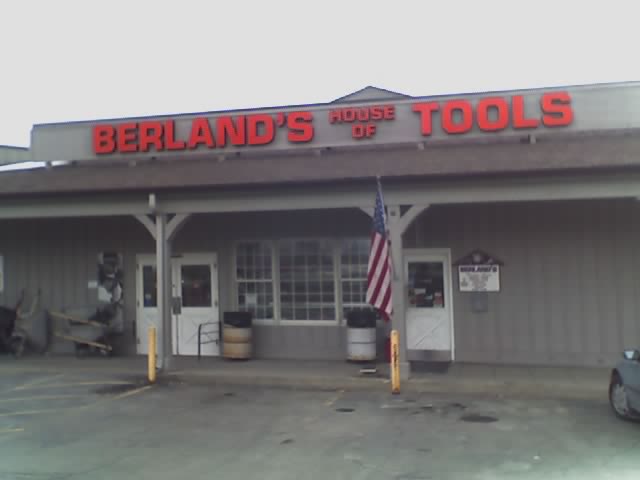
So, I was recently in Chicago to interview new applicants to the Trauma School. While there I took the opportunity to make a pilgrimage to the be all end all hardware store:
Berlands House Of Tools
(You should hear a chorus of angels behind that - more HTML to learn).To the uninitiated I have never really been able to explain the significance of this holy site.

 It is different entirely than any local place of worship, say a Home Depot, and even dwarfs the piety of someplace like a Woodworker's Supply. In short, like Bath Industrial Supply and a short list of other extreme cases, Berlands is a holy of holys.
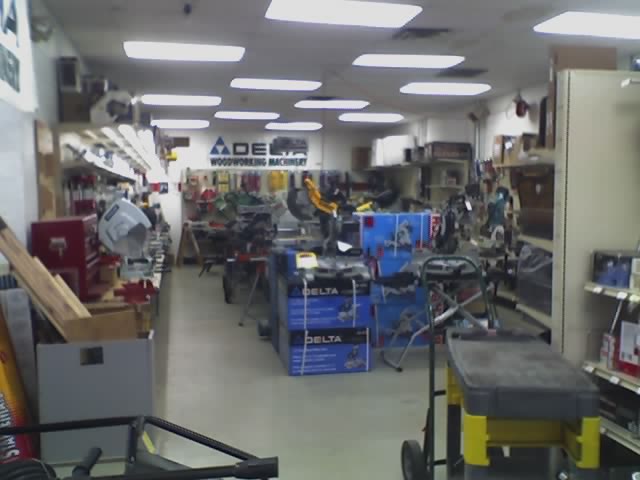
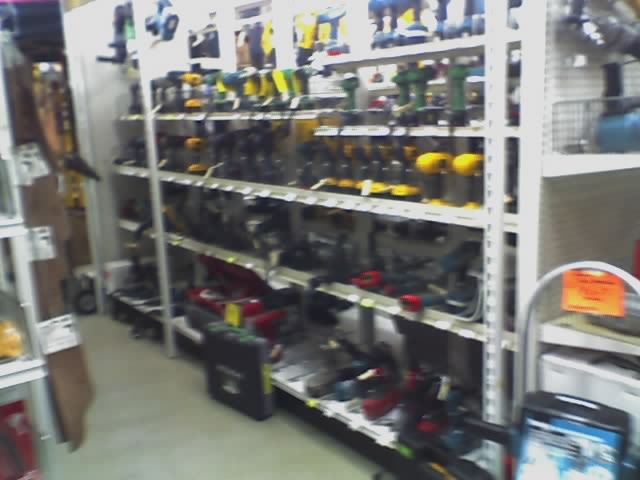
I've included a few pictures here so that you might be able to share in my religious zeal and begin to understand the depth of the experience - the immersion, the Baptism in the nourishing waters of tools.
First we have the welcoming facade of the temple. Then we show the chop saw department. After that are aisles one AND two of the cordless drill selection. This is no ordinary hardware store. I've stuck to the more interesting aisles for photos, but you must imagine the range for yourself, put yourself in the trowel department or the glove department. Really, it is a bounty to behold.
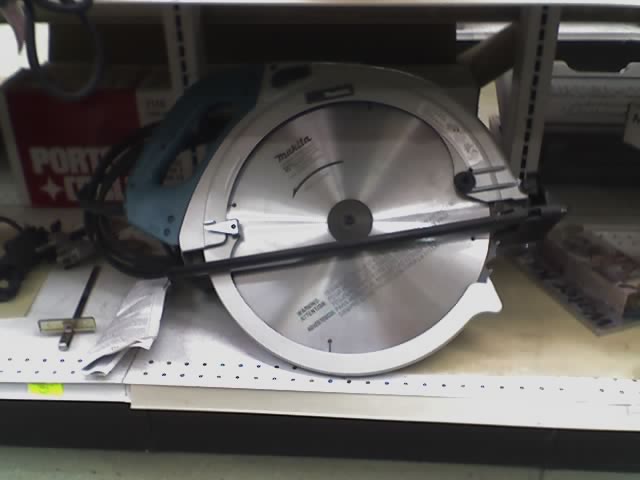
The last two photos are to help to show the depth of the experience rather than the incomparable breadth. From the hand circular saw department we have the Makita Beam Saw. It's difficult to comprehend from simply a photo, but try to understand that the blade on this saw measures 16". It is a true tool's tool.
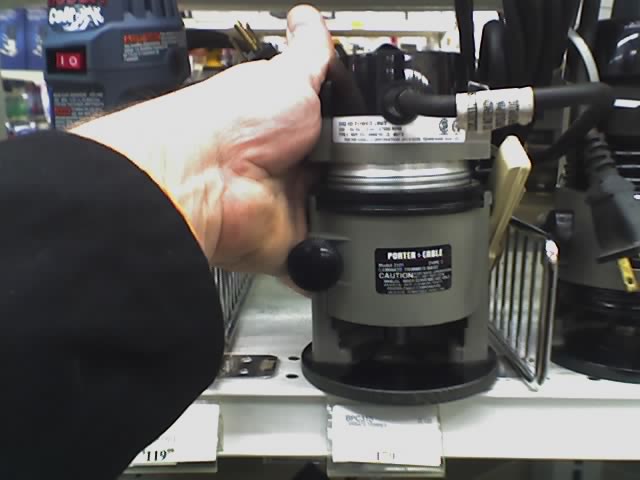
Finally, we have the midget router I have coveted since I worked at CSSI over a decade ago. It presents itself as a laminate trimmer, but really I believe this to be the patron router of scenery construction. It is just perfect for routing off masonite or lauan facings as well as breaking the corner on something to actorproof. It also has a full metal body and base - no plastic - indicating this is no weekend warrior's tool. Alas, I never seem to be able to put my hands on one when I have the funds. But I will know as long as it is available, it will be available at Berland's.
Amen.
Validation

Really, I'm not sure when rigging became my "thing." I was just explaining the other day that its been more about having the (mis?)fortune of working in space after space that hadn't been optimal for stage rigging: Kresge Theatre at CMU, both Apple Tree spaces, the Barber at Northwestern, The Yale Rep, The Marriott Lincolnshire. All theatres where something other than the rigging of scenery had the priority during their conception, and therefore all theatres where you pick up significant rigging experiences. I wonder if every theatre I had worked in would have been the same as the b-flat double purchase house I worked in during high school if I would have learned nearly as much.
So here I am, an ETCP Certified Theatrical Rigger. Who would have thought?
Wednesday, February 08, 2006
Numerology
Should I place any credence in numerology? If so, I think I ought to be playing the lotto this week - or running for something.
- A couple of days ago I got to my hotel room 16234 at 2:34PM.
- A few nights ago I finally put down my book at 2:20, I was on page 220.
- The next night I finished that book at 2:20.
- Today I got in the car at 4:44PM, the thermometer next to the clock said it was 44 degrees.
Do you think that this sort of thing happens all the time and I am only just noticing it over the last few days? Or is there some sort of bizarre numerical alignment going on around my life right now?
If there is some sort of magical thing going on, I wonder what the best way to take advantage of it would be? Certainly lottery tickets jump to mind. I could hurry up and do my taxes, some magic is always welcome there. Maybe I should step on a scale? Although I doubt any supernatural force will help in that department. So many possibilities.
Anyway, its probably nothing.
Sunday, February 05, 2006
They're Hard Not To Like
You know, every time they do one of those Parker-Randel El-Ward things and it works it is really hard not to smile. They really are hard not to like.
Now, if the Yinzers can just keep the celebrations on the right side of the law.
Halftime
Well, a few close calls, but I guess that's not as bad as it could have been. Can't say as anything has really jumped out as far as commercials either (although something new from the Wachowski brothers is always good to hear about). I guess I liked the guys up on the roof.
I wonder if they'll hold on. I wonder which way few cars in Pittsburgh get burned. Time will tell.
Thursday, February 02, 2006
But I LOVE Office Depot!!!
Not tonight however. You would think that if someone runs a copy center as part of their business that there would be a reason to use their copy center. It is possible you might be wrong.
This evening I arrived at the school copier with a stack of papers that needed 2 into 1, 2-sided, saddle staple copying, pretty hard core. As usual I arrive at the copier to find the trouble display lit. It was out of toner. Being one of the few staff members undeterred by a copier trouble display I diligently looked for the toner so as to refill it. Of course, we had no toner.
At this point I say to myself that I didn't want to fold all of the output anyway, and dammit I have a company charge card, and I just LOVE Office Depot, and they do copies...
So I am at Office Depot, and the girl takes my stuff and they have two machines that will do this and so I think, Great, be done in a snap. That is until the first machine jams after only a few pages. It proceeds to do this every couple of pages, over and over. Now you might surmise that if the document requires 2 into 1, 2-sided, saddle stapling, that it might not be a very small document - and you would be right. I also had two different documents that needed this, and I needed 50 of each. So each time I heard the woman crack the case of the copier to pull out jammed pages I cringed just a little bit.
Then the other machine crapped out.
Now, I just LOVE Office Depot. Its like a little museum of office supplies to me, and I love office supplies. So while the copiers were doing battle with my documents I took the tour. I went through post-it land. I visited Avery-land. I went to see briefcases and laptops. I even stopped at clearance, it all took about 15 minutes. Then I went back to the counter to see how my job was running and there were less than 10 of each.
RRR. I am loving Office Depot less every minute.
Finally after about 45 minutes I tell her that 25 of each will have to do because I am getting old. She seems relieved as the manager came to pull her drawer and I think the job was looking like it was going to run past closing. To get to the 25 she had to finish one on one machine and then run the last four of the other on the same machine as the second copier had by now completely shit the bed.
Amazing.
In a million years I would not have thought that, had it been running, the copier at work would have been just as dependable and faster than the ones at the copy center. Astounding. I guess maybe I will have to learn to accept this flaw, like one does in any relationship.
Wednesday, February 01, 2006
Factcheck.org TANBI Style
So, frequent reader Josh decided that my rant against the oil companies should not go unchallenged...
Here's his results:David-
You recent blog post piqued my interest... and I decided to do some research.
I had no idea what I would find, and therefore, did not go into this with any particular slant... except to say that, politically, I tend to distrust massive unregulated corporate entities.
Thought you might be interested in the results.
I make NO claims that this is a complete or accurate analysis of gasoline prices... merely that it is interesting.
The data is from two websites:
http://tonto.eia.doe.gov/dnav/pet/pet_pri_spt_s1_w.htm
http://www.eia.doe.gov/oil_gas/petroleum/data_publications/wrgp/mogas_history.html
The trendlines are polynomial 6th-order (in Excel), and I calculated the derivatives myself to try to answer the question: "Are gasoline prices increasing at a faster rate than crude oil prices?"
I used the rough metric of 19.5 gallons of gasoline produced per barrel of crude oil.
Enjoy.
-J


So, if I am reading his work properly, it would appear that the price of oil has increased faster than the price of gasoline. Which I guess you can spin into saying "they are cutting us a break because they haven't passed the full increase on to consumers."
Perhaps.
I interpret the data a little differently. My conclusion is that the price of gasoline is not volatile due to the price of oil. This makes me even more cross, because if they made 300% of what they did last year, and if the increase in prices at the pump is not dependent on the price of oil, then this just means that the price we are paying is what someone in a smoke filled room somewhere thought they could get us to pay without raising hell.
I think we should show them they were wrong.
Writing Is Rewriting
Roll Me Away
With all the high tech apparatus currently being coveted by entertainment programs around the nation it is sometimes easy to forget that many problems can be solved by decidedly low tech, more traditional approaches. In fact, there are several recurring challenges within technical theatre that cry out for easy, kind of "dare to be stupid" solutions. Things like a door in a drop, a low profile wagon, a tall rolling thing that doesn't fall over are all issues that never go away and are never once and for all solved.
I continue to believe that the purpose built solution is one of the coolest things about theatrical technical direction.
Another frequent poser that could be added to the list above is: rolling thing that doesn't roll when its not supposed to. It actually turns out that this particular problem is one that is much easier solved in a high tech environment. A rolling unit on an automation deck with a buried track, driven by a dog on a cable, stops when the cable stops and goes when the cable goes. However, many Technical Directors are faced with this issue on a regular basis working with companies that do not have the resources to implement solutions involving track decks and drive winches. They have to find other ways.
The band-aid solutions to this are usually triangular wedges stuck under the edge, or door stops on the sides, maybe locking casters, or sometimes cane-bolts into holes in the floor. Sometimes you can even find toggle-clamps listed in theatrical supply catalogs as “wagon-brakes.” Most of these work with varying degrees of success. The upside is that they are usually simple and can be added late in the process. The downside is that often the unit doesn’t have a good position for wedging or attaching. Often multiple stops are required to keep the unit from pivoting as well as stopped, and in the case of wedges there are now extra pieces that someone has to remember to remove with the unit. It is possible though to have a much more successful solution to the problem if the device for stopping the unit is designed into the piece from the beginning of fabrication.
A recent project in our shop provided three opportunities to solve this problem in three different ways in one 24 hour period. The different approaches each have advantages and disadvantages, but are all viable, and on the whole are very simple. In two of the cases, the parts for the solution are within the standard inventory of most scene shops.
The first solution came right off the designer's elevation.
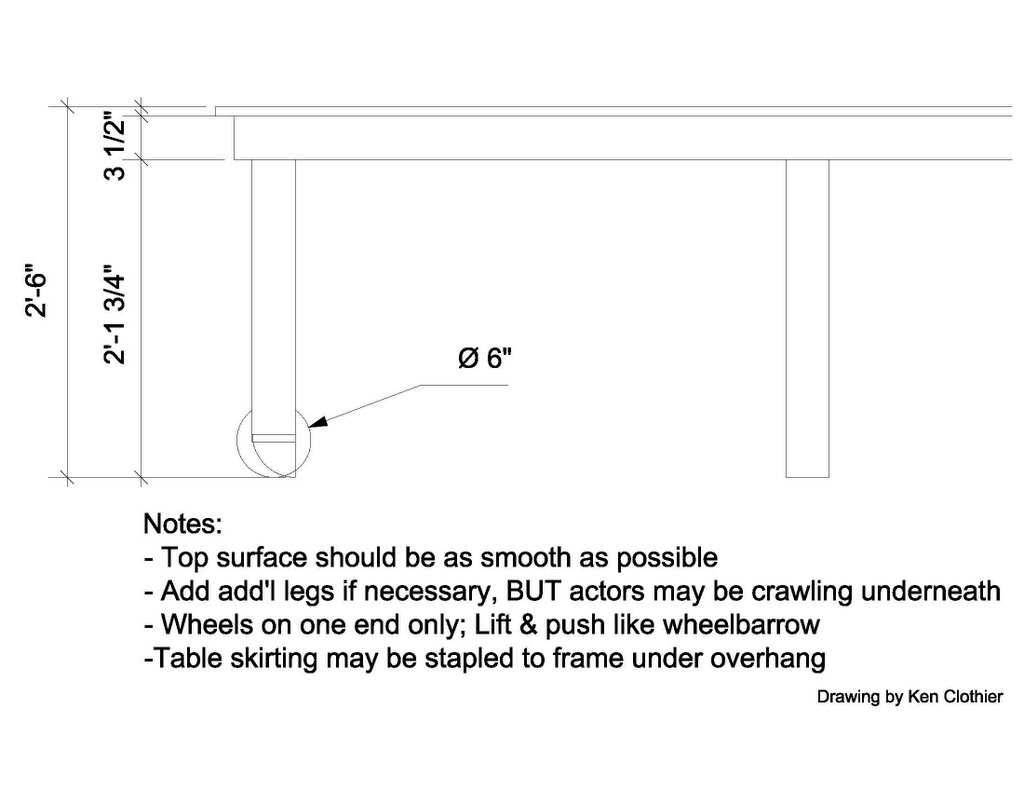
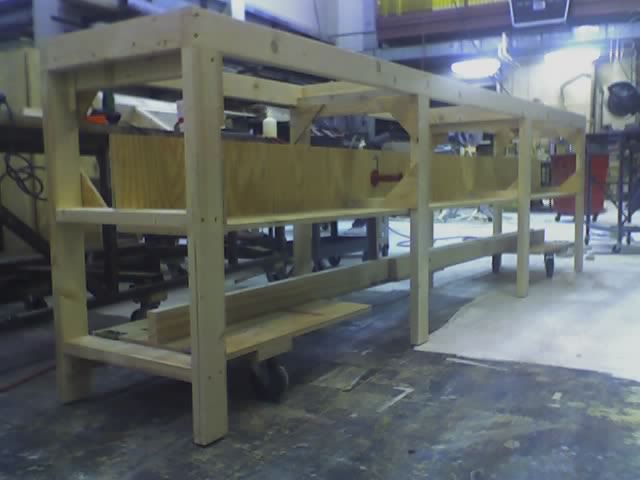
For this table piece we were instructed to caster one end of the unit. Wheels on one end, plus doctoring the legs on that end produce a unit that can be lifted like a and pushed on or off stage. When the un-wheeled end is placed on the ground, the unit sits flat and doesn't move.
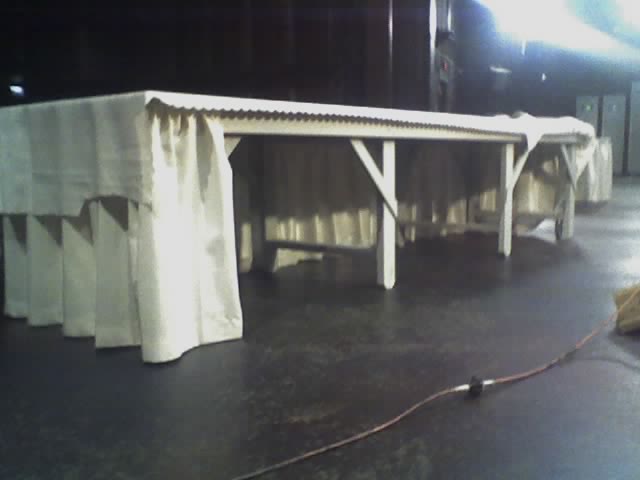
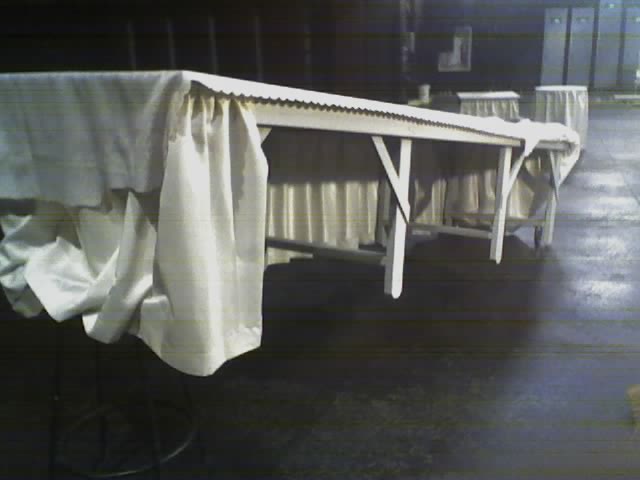

This was a good solution in this case as the unit travels only out of sight, and because actors will be crawling underneath as part of the stage action; so it was necessary to keep the area underneath as clear as possible. Also, it is about as low tech as one can get. No materials are required for this solution beyond what would have been used to make the unit roll in the first place – in fact, it utilizes less casters in this configuration.
It is worth noting that the framing member supporting the casters gets extra reinforcement at the joints where it joins the legs since it will have to bear most of the weight of the unit on its own. Also notice that this approach uses rigid casters. The wheelbarrow action allows for any path without using pivoting casters. Really, this is a dare to be stupid solution that does everything it needs to do for the production without being complicated.
The second approach uses a few moving parts, but is also reasonably simple. This is a fairly classic lift-jack utilizing pivoting casters, strap hinges, a plywood mounting plate, and a long 2x4 lever. Once again, materials that are normally close at hand to any theatrical scene shop.

The wheels for the unit are mounted to the pivoting plates. Each plate is connected to a lever, and the levers are situated such that when one moves it moves the other.
Push the levers down, the plates rock to level pushing the wheels down, and the unit sits up on the wheels to roll away. This particular application utilizes an additional arm with a handle to facilitate operation and locking. In most cases the weight of the unit itself is enough to pivot the jack into the stored position.

This solution was good for this application because there was a good deal of available real-estate within the piece for the mechanism. The scene shift takes place in view of the audience, so once the piece gets its front and side facings this should be reasonably magical. The jack does require a fair amount of space, but with proper planning space can be optimized for other uses of the volume, in this case a shelf for props.
The engaging and disengaging of the mechanism can happen with one stagehand – or even a performer - from a single position. Also the piece only has to carry its own weight so the number of casters and span between the wheels turns out not to be an issue. If the lift jack is actuated from the end of the long lever, the operator gains significant mechanical advantage, so even a unit with some weight to it should not be too unreasonable a challenge to lift, as long as the structure of the mechanism can handle the span introduced.
The third iteration is a little more complex. This approach utilizes moving parts, some actuators, and a stored power supply - compressed air.

In this solution, the casters are mounted to a free floating plate contained within the base of the unit. Above the moving plate is a fixed plate, and on that plate there are multiple pneumatic cylinders. A valve is placed between the air supply and the actuators. Apply the air and open the valve, the cylinders extend pushing the unit against the wheels and raising the piece off the floor - free to roll.
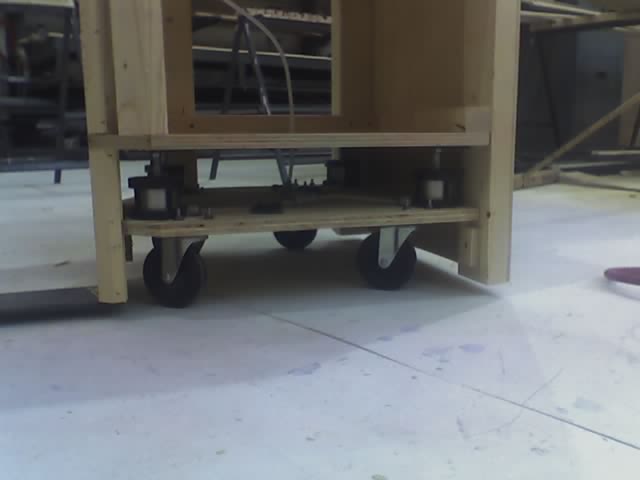
Remove the air supply and open the valve and the unit sits back on the floor. The weight of the unit is enough to exhaust the air from the cylinders so the unit is “gravity return.”
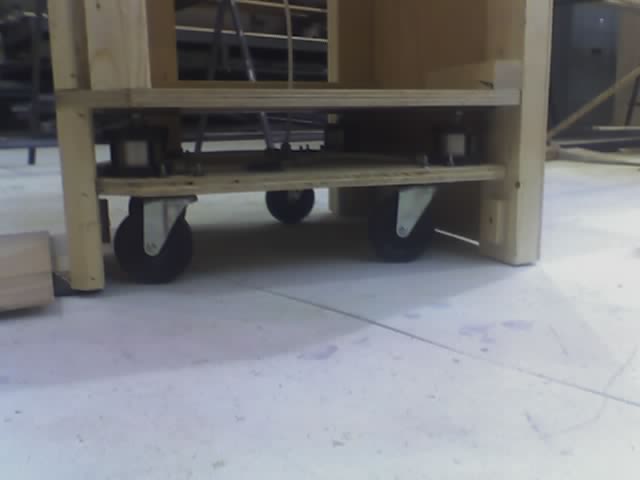
In addition to the wheel, plate, and cylinder assembly, this solution requires finding a position to conceal the pressure tank. There also needs to be an accessible place to mount the valve & handle.
This is a good solution for this piece because there is very limited space available. This also works well because this unit actually is a doorway arch, so there are two bases that must lift and there is no way to mechanically link them. Snaking a hose through the header frame to power a second set of cylinders is comparatively simple. Perhaps most interestingly, this solution is completely encased in a unit which does not have an elevation hidden from the audience. When looking at the unit in place, one cannot see any of the mechanics that make the lift possible.
So, three solutions, no wedges, no holes in the deck, no electronics or programming. Just simple machines and a little forethought for three clean solutions.
Subscribe to:
Posts (Atom)