Wednesday, October 03, 2012

Worth A Look

Here are five articles from last weeks Greenpage that might be worth your time...

'Trek' star's own history inspires new musical

The Denver Post: George Takei has plenty of practice exploring strange new worlds on TV and film, but delving into a painful time in his family's life onstage is something even he never imagined. Takei and his family were among thousands of Japanese-Americans put in internment camps during World War II. The 75-year-old "Star Trek" actor's memories inspired composer/lyricist Jay Kuo to write "Allegiance—A New American Musical," which has high hopes of making it to Broadway.
 

Just A Song (Fully Cleared For Public Performance) At Twilight...

livedesignonline.com: Obtaining rights for the use of copyright music in theatre productions, both in the US and in the UK, can be a tortuous task. Increasingly, major labels want to negotiate on a per-show basis, but their frame of reference is often limited to film or television, and their awareness of the state of most theatre companies’ financial affairs is virtually nil.
 

Updated Edition: Show Networks and Control Systems by John Huntington

Briefingroom on LiveDesignOnline: Author, educator, and industry veteran John Huntington has released Show Networks and Control Systems, the completely updated and revised edition of his industry standard reference text, which was previously titled, Control Systems for Live Entertainment. The book includes an in-depth examination of the control and networking technology used in lighting, lasers, sound, stage machinery, animatronics, special effects, and pyrotechnics used in concerts, theme parks, theatre, themed retail, cruise ships, museums, interactive performing arts, and special events.
 

Not to be passed by

The Stage: The true path towards acceptance and integration of minorities isn’t made, of course, when special pleading is made for them but they’re happily, healthily and naturally integrated into the way of things. It’s why colour-blind casting in the theatre is so brilliant; both Derek Jacobi and currently Jonathan Pryce, playing the title role in King Lear at the Donmar Warehouse and Almeida Theatres respectively, had one of their three daughters played a black actress — respectively Pippa Bennett-Warner (as Cordelia) and Jenny Jules (as Regan), without comment or surprise.
 

Live Sound: The Old Soundman: Dealing With Getting Walked On

Pro Sound Web: “Getting ahead without being a jerk” is actually what our young friend said he wanted to discuss. I will use the pseudonym “Oz Man” for him due to the volatile nature of his dilemma! Notice that he is so distraught that he offers no salutation!

Tuesday, October 02, 2012

Haiku Deck

I did these slides for a guest appearance today in Tech Management. The content isn't so spectacular, but of interest might be the platform. These were composed on my tablet using an app called Haiku Deck.

Monday, October 01, 2012

Ellipses...

Sometimes being away for a week feels like forever, and then other times it feels like I was never away at all... Of course the moment I return to Pittsburgh from Las Vegas I find I have another reason to be in Las Vegas in like two weeks... Remarkably little appears to have changed on the Chosky stage since I left... It takes more than 20 minutes to recap what the Nav class did in four days... Got myself 32 ETCP renewal credits for going to class... Last couple of times I have done things under the heading of "it can't hurt to ask" I've done pretty well, probably due for a miss... The TV I bought more than a decade ago decided it was through last night. We're going to try to rehab it but I am not all that confident... How much is too much to spend dressing up the back of your house? Not much, right? That's what I thought... The whole out of town trip I used the IOS6 Maps program for turn by turn navigation and never got lost. Still, I find myself defaulting to Waze instead... I don't know how it happened but it appears my fantasy team won this week. We're 2 & 2... The ziplines at Seven Springs are pretty cool, especially that last one - 1500 feet and like 30 seconds of travel. Highly recommended... Shows just piling up on the DVR but all I seem to be interested in is Primeval on Netflix (still, Homeland ought to change that)... If we're counting how many times I have walked to work since moving we'd know it wasn't a very large number... I started a garage organization project like a month ago and walked away half finished. I should put away the rest of the stuff even if I'm not through... Still really liking the new office layout & design... Haven't made any headway on the Weekly Greenpage Podcast. I guess mostly the lack of progress is due to my not telling anyone. Funny how that works... I wrote a real turd of an email today to one of my colleagues. I hope he doesn't get too much on him... Some day I will learn to spell colleagues... I did a presentation deck tonight on the tablet with this service Haiku Deck. Not very specific, but then I think sometimes that's a deck's biggest problem... Decided today not to buy one of the gadgets I have been coveting. Probably for the best...


Friday, September 28, 2012

Nav Class, Day Last

Woosh!  That went by quickly.  So much information, my brain runneth over.

I can't so much remember what we did today.  I think we started off talking about the "find sensor" cue type.  It's used for rezeroing an axis.  We also talked about wiring in, mapping and scaling the absolute encoder.  This was followed up by going into the lab and doing the actual absolute encoder installation and then calibrating it (that's the scaling part).  After that we wrote cues such that from a power up where the device would not know where it was we could dependably get to a sensor, rezero, and move to a home position.

I guess rezero isn't a real word.

The afternoon was largely "go back three spaces."  We didn't unwire anything (thank goodness) but we did strip away everything in the computer such that we had to reconfigure the system from scratch.  That's reinstalling the I/O Bus, map all the cards, find and assign all of the devices to their proper inputs & outputs, and label and tag all of that in the machine.  From there we reinstall the Axis I/O device, mapping all of the K-Bus items to the correct corresponding Axis I/O features.  Once that's done all of the settings need to be addressed: velocity and position references, scale the encoders and set the wrapper values.  Finally rewrite the cues and rules to restore the functionality we had before lunch.

That list is likely missing several items, and that is indicative of our success level.  We got stuck a few times.  It was hard to find some of the inputs & outputs.  In the end we got the thing working, but had it been a day of show disaster where Kevin and I had to get the thing repaired - we wouldn't have been able to do it ourselves.  Probably too much to ask for of a 4 day class.

We had some time left at the end so we talked about targeting and PID - how to make the unit find its spike smoothly and quickly.  At the outset we were typically missing by 0.03 feet.  After tuning we got it down to a repeatable 0.001 feet.  Not bad.

The last thing we talked about wasn't really part of the class.  I was sent here with a mission to discover if and how Navigator could send position data to a projector to update focus based on a moving target.  It is possible and we went through how to do it.  I am not confident I will remember any of it though.

Really, really good class.  Highly recommended.


Comment of the Week

Vote for the comment of the week.  Here are this week's contenders.  Put your vote in the comments for this post:

Comment #1: a new comment on your post "Should Government Fund "the Arts"?":

Are you fucking kidding me?

After one opinion piece everyone is all of the sudden is, "Oh you know what maybe governement should cut funding for the arts?" "Maybe they should direct that funding to schools instead." Here's a wakeup call people - the government wants to cut funding to both arts and education. If one goes, they both go. There's no common ground. But even if that wasn't the case, what good does it do to continue to supply funding for education and training if there is no industry for those students to enter? We have now introduced even more individuals crippled by student loans into an economy that can't support them and they can't support their debt?
I can't understand how someone can justify a death sentence to the arts (there are a lot of theaters who depend on the NEA to stay afloat) just because their government has a problem prioritizing expenses. Did no one think that just maybe, if are country was so addicted to war than maybe the government wouldn't have such hard time paying its bills? No that's okay, I'm okay with killing Afgahni citizens even if that means I'm going to work at Walmart for the rest of my life. It's okay though because I can watch TV when I need the arts.
Maybe we should look at the root of the problem - the government itself. Why should we compromise our lifestyle and interests? We have the power to the change the government, to align ourselves with fiscal policy that benefits our interests. Doesn't it make sense that we start there?
Comment #2: a new comment on your post "Seurat's Masterpiece Comes To Musical Life in Surp...":
I am SO happy you posted this article. This summer, I helped to paint the set of Sunday in the Park with George at a children's summerstock theatre in New York. After painting the set completely in pointillism, I had a new appreciation for Seurat and for the art of pointillism as a whole.

I love that Sunday in the Park is a theatrical piece of art which is based off of an artist, and the art in which he created. It is absolutely brilliant, as Kael said, for the Chicago Shakespeare Company to promote themselves in this fashion. If I were in Chicago, I know that I would not have missed this event, and I would certainly not miss the show as a result! It is great that the Art Institute collaborated with Chicago Shakes to bring this event to life. It is also really cool to see collaboration taking place amongst various art forms, not just within the theatre community.
Comment #3: a new comment on your post "Why Doing Awesome Work Means Making Yourself Vulne...":
Ugh. This woman is far too obsessed with herself and how great she thinks she is. Also the title of the article has pretty much nothing to do with what she actually wrote because all that she wanted to write about is how excellent it is to be herself whether she is an actress or a playwright. There was no vulnerability here only a lot of self love. Which is too bad because I agree with at least the title and would like to talk about that instead of how magical it is to be an actor/playwright. I think that if you're doing anything creative you really need to be reaching into a vulnerable place in order to achieve any kind of success. The critique/review process is very important. You need to be able to listen to people say why they don't like your work sometimes, and you need to analyze those comments without getting offended. Also the best work comes out of a vulnerable corner of people's brains. Everything there is much more honest and interesting than the creative equivalent of this woman's article, where everything is magic and perfect and great in the world of Me!
Comment #4: a new comment on your post "State, Strip Club Fight Over Taxes":
Wow, this article was eye-opening... I guess I've never thought about whether strip clubs "count" as performance spaces, but now that I think about it, I'm not sure that they are much different. I don't think that it's fair of the prosecution to say that because the strippers aren't necessarily trained, that means they are not dancers. Street dancers aren't trained. The article points out that Eric Clapton wasn't trained either.

I don't agree with Jacquelyn's opinion about self expression v. performance... I don't think you can separate the two. Ballet dancers perform for the product and the pleasure of the audience. Some strippers may do the exact same thing. It could even be a means of self expression... why do you think there are pole-dancing classes popping up at every gym? I'm not saying that I think that pole-dancing is the epitome of self-expressive art, but I do think that the government shouldn't have the right to decide whether it's a performance. 
Comment #5: a new comment on your post "More SawStop BS":
I couldn't agree with this article more; and even better than its sentiment is the heart-on-its-sleeve language that implies safety starts with BEING CAREFUL. If contractors buy a table saw and immediately take off all the guards, what makes anyone think contractors won't do the EXACT SAME THING and disable the sawstop tech on their now more expensive table saw.

Hmm, the guy bought a brand new table saw, took all the safety devices off and then made a dangerous cut made MORE dangerous by not using ANY supplemental tools (miter gauge, etc). And he got hurt. Yeah, it's the tool's fault.

Thursday, September 27, 2012

Nav Class, Day Three

This is getting to feel kinda long.  I never felt it when we did four day classes at CMU, but four days here is a lot of hours into this training.  This morning you could tell we were kinda beat, we didn't even make 2 hours before we took a break because people were dozing a little.

How did the day start?  We were back in the classroom talking about Analog outputs, how to wire them and how to map them into the I/O device.  We also spent some time talking about the rules we'd written yesterday - specifically about "general" and "enable" conditions and what kind of thing ought to be what.  After that we went out to the lab to wire up and assign the I/O Bus analog output to the motor drive so that it could control the speed of the motor.

Not many pictures from this trip so far.  Here's the rig we've been working with (there are two separate rigs in the photo):


Kevin and I have started to talk about the possibil;ity of putting together such a thing for PCA209.  I checked today and this rig actually takes 120VAC instead of 3 phase 208, so we could set one up in a classroom without installing more power.

Setting up speed control required changing some drive parameters and then doing the wiring from the I/O bus to the motor drive.  At this point it wasn't mapped to anything in the control, but we could select the parameter directly to adjust it.

After lunch we went back to the classroom to discuss the Navigator Axis I/O device.  This is a virtual device, gathering up the I/O's and clumping them into a single device that has many preset features.  As it turns out, most of the rules we wrote yesterday to govern things we'd put onto the bus are regular features that Navigator knows how to deal with as part of an Axis device.  So instead of wiring and attaching a limit switch and then writing a rule that says when the limit switch is tripped the motion should stop you can wire and attach a limit switch, install an Axis device and then tell Navigator the input is a limit switch and from that point Nav knows what to do with it.  It mooted a lot of the work from yesterday, but I feel like it was still really useful.

Around this point I started to feel like most of the Axis I/O is centered around running a non-FTSI winch.  The rub here is that our winches are FTSI and run native under Navigator, so if we make a new machine it will in all likelihood not be a winch and so might not work as gracefully with the general set up of the Axis I/O.  Kevin and I started to try to think how each thing we were talking about would apply to a turntable or an electro-linear actuator.  A lot of that stuff seems like it will just wind up being on/off, and that type of control can happen right off the bus instead of using the Axis device.  We're thinking about making up a turntable simulator back in Pittsburgh to see how well it works.

Here's a bonus photo:


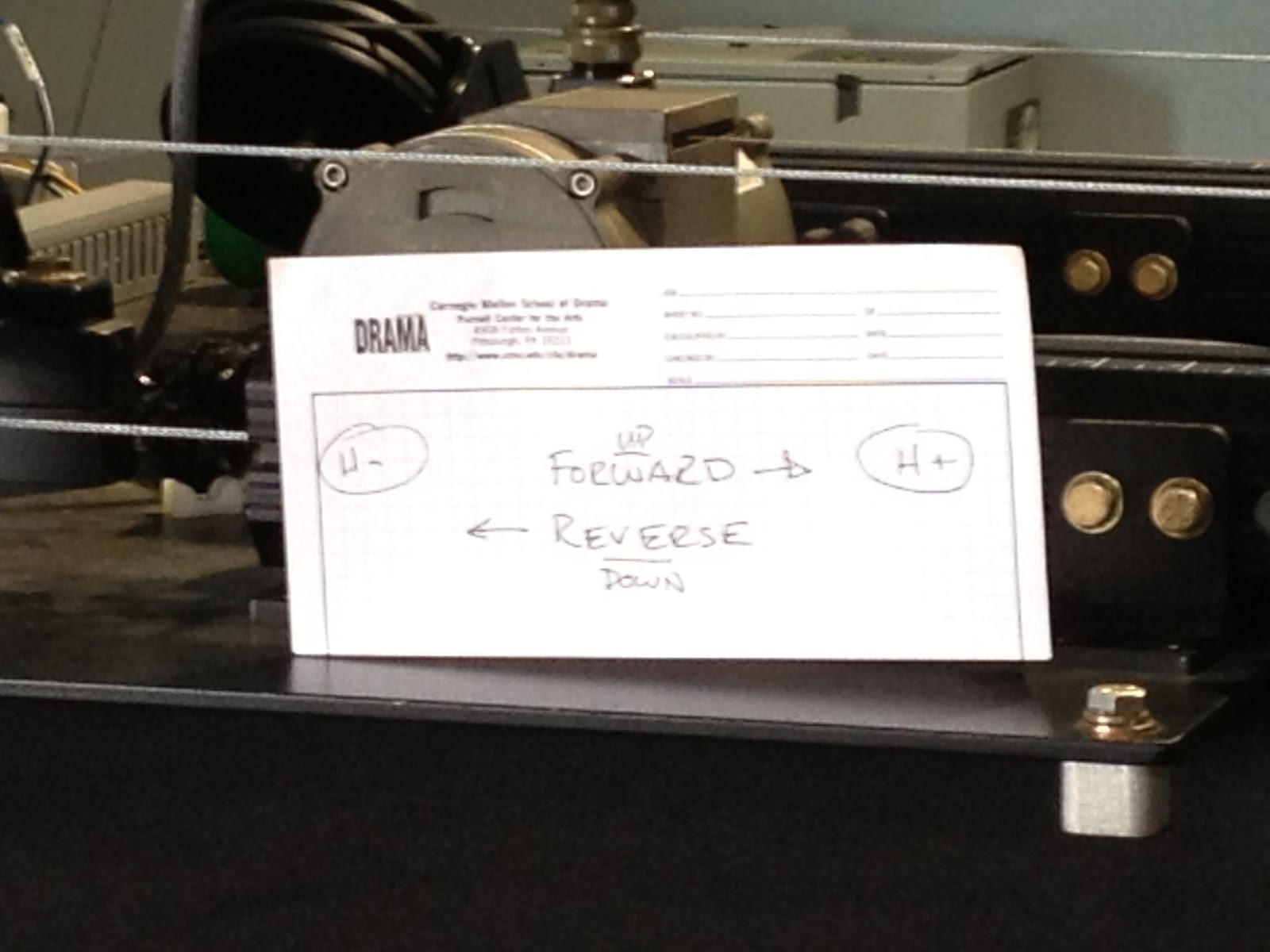
This was the stuff that was making my brain hurt yesterday.  We kept haing to match turning a bit "on" or "off" with "up" and "down" or "forward" and "reverse" when every one of those parameters was arbitrary (as well as remember which was the "H+" and "H-" limit switch at the end of the track.)  Today I decided a sign would be better than drinking after.

The next part of the afternoon was installing the Axis I/O and then writing cues for the Axis device to mimic the rules we'd written on the I/O bus yesterday.  It might have been possible to do this with one rule and one cue, but we settled on three rules and two cues (I think).

Finally we had classroom time to talk about analog input via encoder and how to calculate speed and position from an incremental encoder.  There was much discussion of absolute and incremental encoders and encoder counter cards and then about wrap values (like a scoreboard rollover) and scaling - making something like 0-60000 counts into recognizable speed or position.  And then back to the rig to impliment the speed control and position controls on the Axis device.

Each day feels thinker than the last.

Worth a Look

Here are some articles from last week's Greenpage that might be worth your time:

Seurat's Masterpiece Comes To Musical Life in Surprise Sunday Performance at Art Institute (Video)

Playbill.com: Think of it as an Impressionist flash mob. Visitors to the Art Institute of Chicago got a musical surprise on Sept. 16 when at the top of the museum's Grand Staircase leading to the Impressionist Galleries, a full-sized replica of Georges Seurat's "A Sunday on La Grande Jatte—1884" was installed but devoid of most of the foreground characters.


Steve Jobs’s Complicated Views on Passion

Study Hacks: At a recent media panel, Walter Isaacson remembered the following conversation with the late Steve Jobs:
I remember talking exactly a year ago right now to Steve Jobs, who was very ill…He said, “Yeah, we’re always talking about following your passion. But we’re all part of the flow of history...


California Power Saw Safety Bill AB 2218 Dies in Senate

Professional tool reviews for the average Joe: Last week, the state Senate failed to actually do anything with AB 2218, a rather troublesome yet persistent consumer safety bill that would mandate "injury mitigation technology" on all table saws sold in California.


State, Strip Club Fight Over Taxes

WSJ.com: The answer may seem obvious, but it has attorneys in Albany arguing: How is a ballerina different from a pole dancer? New York's highest court, the Court of Appeals, will hear arguments on Wednesday in a case pitting the state's Department of Taxation and Finance against a strip club called Nite Moves that is situated about 15 minutes from the state Capitol.


My Dramaturgical Secrets

2AMt: I have a secret; I’ve started to doubt that dramaturgy is a job. I hadn’t heard of dramaturgy until I held the title. I was instructed to help with research but I offered much more to the room. And in my first production as a “dramaturg” I could see in conversations with the director, actors, playwright and designers that I had a place in that room. I also could see that though I can write a program note, design a informative display for the audience and do research, that is no where near the full thrust of the job I was doing. I knew that my work directly had an impact on the success of the production and I saw my desire for a life as an artist surrounded by artists was coming true.

Wednesday, September 26, 2012

Nav Class, Day Two

Back at it today.  We had a long, chock full day of class.  So much so that at the end it was difficult to remember what we had done at the beginning.

I think we started out talking about analog inputs and outputs.  We'd done digital yesterday so moving on to analog was a natural progression.  We got a little derailed during this discussion while talking about scaling the values.  Analog values have a pre-scaling offset, a scale, and a post-scaling offset.  Coming to a good demonstration of that got confusing.  Suffice it to say if you are going to pick round numbers to make the math easy don't pick the wrong operation for those numbers lest you confuse your students who are following the math.

After the discussion we went to the lab and wired up two analog inputs: one from a pull string pot and one from a dial pot.  These were slightly more complicated than their digital cousins because they have an extra line: "the wiper."

From there we went back to the classroom to take about relay outputs.  These are different from digital outputs because they are a gate to pass something through rather than just sending a signal or not.  I got confused here because of my prior training with relays being mostly about SSRs.  I kept looking for how we were going to wire in a "control signal" but this doesn't have that as it is implicit in the I/O module.  It looks odd to have a "relay" with outwardly only one side of the thing, but I got my head wrapped around it.  Most of the relay discussion revolved around E-Stop setups.

Getting relays in our kit allowed us to wire in an E-Stop contactor in the lab.  And once we'd done that it meant we could wire in the motor drive and make things go (after doing a bunch of operations & indicators to flesh out the E-Stop functioning).  We had to set some parameters in the drive first, so that was new.  Then we wired up and assigned remote controls for the drive: go/stop, right/left, and speed.  I had a good trouble shooting moment here when we couldn't make the remote functions work: noticing that there wasn't just a parameter in the drive for how the signal would be sent, but also that there was one there to listen for the remote signal in the first place.

At which point we had a working motor, control buttons, and limit switches (did we wire the limit switches today or yesterday?  I don't remember).  We spent the rest of the day writing rules to make the rig do various things based on various inputs: one using three buttons and another doing most of the same operation with one button.  Through here I got to the point where I couldn't keep track of things in my head any more.  We had several SNAFUs with running in the wrong direction or using the wrong limit or having rules in conflict (some of which was exacerbated by muddy instructions) but in the end we got everything to work out (and finally finished something ahead of the other team - debugging is much harder through a translator I guess).

Half way through.

Tuesday, September 25, 2012

I/O Class, Day One

So I am in Fabulous Las Vegas (well North Las Vegas) for FTSI I/O training.  Last year we bought a bunch of I/O gear to work with our existing Navigator set up so we'd be able to use additional sensors and trigger other items from our front end - as well as maybe compose some of our own full blown actuators.  Now we're here to learn how to use the gear we bought.

We started out going to the Fisher facility. Neither Kevin or I had been there before.  We did another class in town a while back, but it was at the LVCC.  The shop is out by the Las Vegas Speedway and most of the surrounding businesses are auto and auto racing outfits.  We got our badges and proceeded to another building where we would have class.

This particular class is limited to 6 participants and in fact this time around there are only four people.  So there's Kevin and myself and then there are two guys here from Japan.  They seem to be engineers from a Japanese equipment manufacturer.  They have little or no English so they also have a translator.  Its actually nice for us too because we get an extra moment to digest what's being presented while the translator is playing it back in Japanese.  It's also interesting to hear what words in Japanese are the same as they are in English.

The morning started with introductions.  Dana is overseeing the operation.  We know him from prior classes - he came to do the last round of class we had in Pittsburgh.  He's being ably assisted by Nate.  Nate is actually a Pennsylvania person too.  He's been spending a lot of time at TAIT (along with many of our former students).

The rest of the day was two parts: a classroom part and a lab part.  The classroom content was mostly broad strokes automation background and context: what are the parts of a winch, what makes for I/O, what do we mean by limits, what are encoders and how do they work.  Most of this was review for me.  I did get a new bit of vocabulary: "initial" can mean EOT or a "hard limit."  The lab part was starting to deal with I/O elements.  We set up a GUI/Portal, wired some inputs and outputs, got some lights to go on and off when we pressed specific buttons, and wired an e-stop button.  We also wrote some rules to govern the behavior of the buttons and lights and customized the look of the axis I/O panel on the display.

All pretty cool.  More tomorrow.

Friday, September 21, 2012

Ellipses...

Seems to me like everyone on the internet got to see the space shuttle today except for me... I know Romney is getting pummeled over that 47% thing but I think he didn't really say what he meant. He was talking about all the people that were never going to vote for him... I guess I wasn't paying attention to my fantasy team. I hope I played good people this week. I hope the people I played are playing this week... There was a guy holding a hostage downtown this morning but I pretty much missed it. My media consumption is decidedly not local... Getting ready to run out of town. I wonder if my hotel has a hot tub... DId you see the Simpsons trailer? Voter suppression, tax returns, Obamacare, death panels, Foxcon - pretty dense satire... Really, really enjoying the bluetooth keyboard for the tablet, added a whole new dimension of utility to the device... I tried to watch some of the MA Senate debate the other night, but it got so chippy right from the top I had to stop... Obama is for redistribution of wealth. Isn't "supply side" also distribution of wealth. That's what "trickle down" is all about. The difference is one way we give the money to the 1% and they give it to the 99% as spending and investment. The other way we give the money to the 99% directly - without the filter of the oligarchy... The email I am getting would suggest that the Democrats have relaxed on the White House and are now setting their sights on making gains in Congress. That's what I would have done from the start... How is it possible I haven't bought the new Melissa Etheridge album? I think it has something to do with the nature of digital media...